Dolly, Deep Roots, and the Choice to Trust Yourself
I’ve been thinking about Dolly Parton so much since hearing that she died yesterday. Maybe you have too.
This morning I was scrolling through Dolly tributes, crying in my “Good Golly Miss Dolly” T-shirt that I got on my birthday trip to Dollywood 4 years ago (pic at the bottom of this email).
I also talked to a friend who lives in Tennessee and we shared what we appreciated about her.
I’ve loved Dolly since I was a little girl watching 9 to 5. Even then, I was inspired by the power of her friendships with other women and captivated by her special sparkle. I loved that she could be so feminine and so strong at the same time. Dolly was completely and unapologetically herself, which felt like a lighthouse for young me.
Dolly's legacy is all about love.
I’m not sure what story about her stands out to me the most: her ability to fearlessly dream big while also staying connected to her humble beginnings; the way she used her influence to stand up for people who were different from her and had less power; her unapologetically flirtatious and fierce trust in herself; her razor sharp discernment about what was a yes for her and what was a no; her incredible resilience; and the way she generously loved so many children without being a mother herself.
I’ve gone down many social media rabbit holes this morning, from what she said to Julia Roberts about choosing not to complain about the heat while filming Steel Magnolias to learning about investing some of the royalty money from Whitney Houston’s version of “I Will Always Love You" into a Black Nashville neighborhood. I was wowed by her creative genius all over again when I learned that she wrote that song and “Jolene” within the same short period of time, possibly even on the same day.
Her version of mothering is the part that really touches my heart personally.
Dolly talked about imagining having children with her husband of nearly 60 years, Carl Dean, the names they’d talked about giving their kids, and what her daughter might have been like. She also spoke openly about her endometriosis and fertility struggles and eventually about being grateful that not having children gave her the freedom to build the life and career she’d dreamed of.
She said, “I always say God didn’t let me have children so that all kids could be mine.”
You probably know that Dolly created the Imagination Library in 1995. As of June 2026, the Imagination Library had gifted more than 325 million books to children from birth to five across five countries, regardless of family income. The program also makes selected books available in braille and audio formats for children who are blind or have low vision.
She did it as a way to honor her Dad, who couldn’t read or write, and he was even part of the Imagination Library team. She said, “He got to live long enough to hear the kids call me the Book Lady. He took great pride and felt like he’d helped do something special.”
And the Imagination Library didn’t just mail the books. Each book was addressed to the child, because Dolly knew how special it would feel to go to the mailbox and find a book with your own name on it.
And that detail is so Dolly.
Her self-trust showed up in the details.
When Dollywood made headlines in 2016 for creating a calming room for children and adults with autism who experience sensory overload, she had again followed that big-hearted instinct all the way into the details. The room was developed with input from Autism Speaks and gave families a quiet place to decompress when the sights, sounds, and crowds of the park became overwhelming.
She seemed to trust that what she noticed, what she cared about, and what her heart told her mattered were worth acting on.
Even when that meant doing things differently. Even when that meant wearing an unforgettable signature look that no one else could pull off.
Dolly let herself be Dolly, all the way through.
Dolly was also a steadfast advocate for LGBTQ+ rights. She used her platform to make space for people whose lives and identities were different from her own, and in 2020, when asked about Black Lives Matter, she simply said, “Of course Black lives matter.” She also said, “I believe we all have a right to be exactly who we are” and that it wasn't her place to judge.
There's a connection between all of this.
Dolly loved and trusted herself deeply. And I think that made her less critical and judgmental of other people’s lives, not more.
She didn’t need everyone to make the same choices she made. She could be deeply rooted in who she was without needing to tell someone else who they should be.
I was really touched this morning by an Instagram post by Coach Phi Dang. She said, “Society is still so quick to measure a women’s life by what she produced biologically. Who did you marry? Did you have children? How many? Dolly left behind something far bigger than a family tree. She left behind people who became more themselves because she existed.”
This resonates so deeply with me as someone who had always imagined being a mother.
I’ve thought about baby names and tracked due dates and sat in the front car of that fertility rollercoaster of dreaming, then hope, then devastation, then finding the courage to open myself to other ways this dream might be lived.
My favorite quote by Dolly is this one:
“Storms make trees take deeper roots.”
Deep self-trust isn’t something that just happens by accident.
It doesn’t come from an easy life.
It comes from experience. From weathering things we didn't choose. From discovering that we can survive disappointment and still find our way forward. From making choices, learning from them, and becoming more certain of who we are.
And we can choose what we do with those experiences.
We can choose to trust ourselves, to listen to the quiet voice inside us even when other people have opinions about what our lives should look like, and to let our experiences deepen our roots rather than harden us.
Dolly knew who she was and what difference she wanted to make because she had lived those storms. And instead of becoming smaller or more guarded, she became even more herself. More generous, more playful, and more willing to let other people be themselves, too.
One of my favorite (and most popular!) episodes of Outgrow the Grind was an interview with Carlyn Morris, a friend and former client, and the biggest Dolly fan I know, about how she leans on Dolly when faced with a decision.
“What Would Dolly Do?” is more than just a cute phrase.
This episode is a reminder that connecting with our heroes helps us see the parts of ourselves we admire most and gives us an invitation to lead with those values and qualities too.
Maybe “What Would Dolly Do?” is really another way of asking:
What would I choose if I trusted myself a little more?
What would I stop apologizing for?
What kind of life would I create?
Here’s the episode if you’d like to take a listen:
Ignite Your Inner Resources with Carlyn Morris
Sending love to you today, especially those of you who grew up admiring the power, beauty, sparkle, generosity, and sheer magnificence of the great St. Dolly.
With love,
Stacy
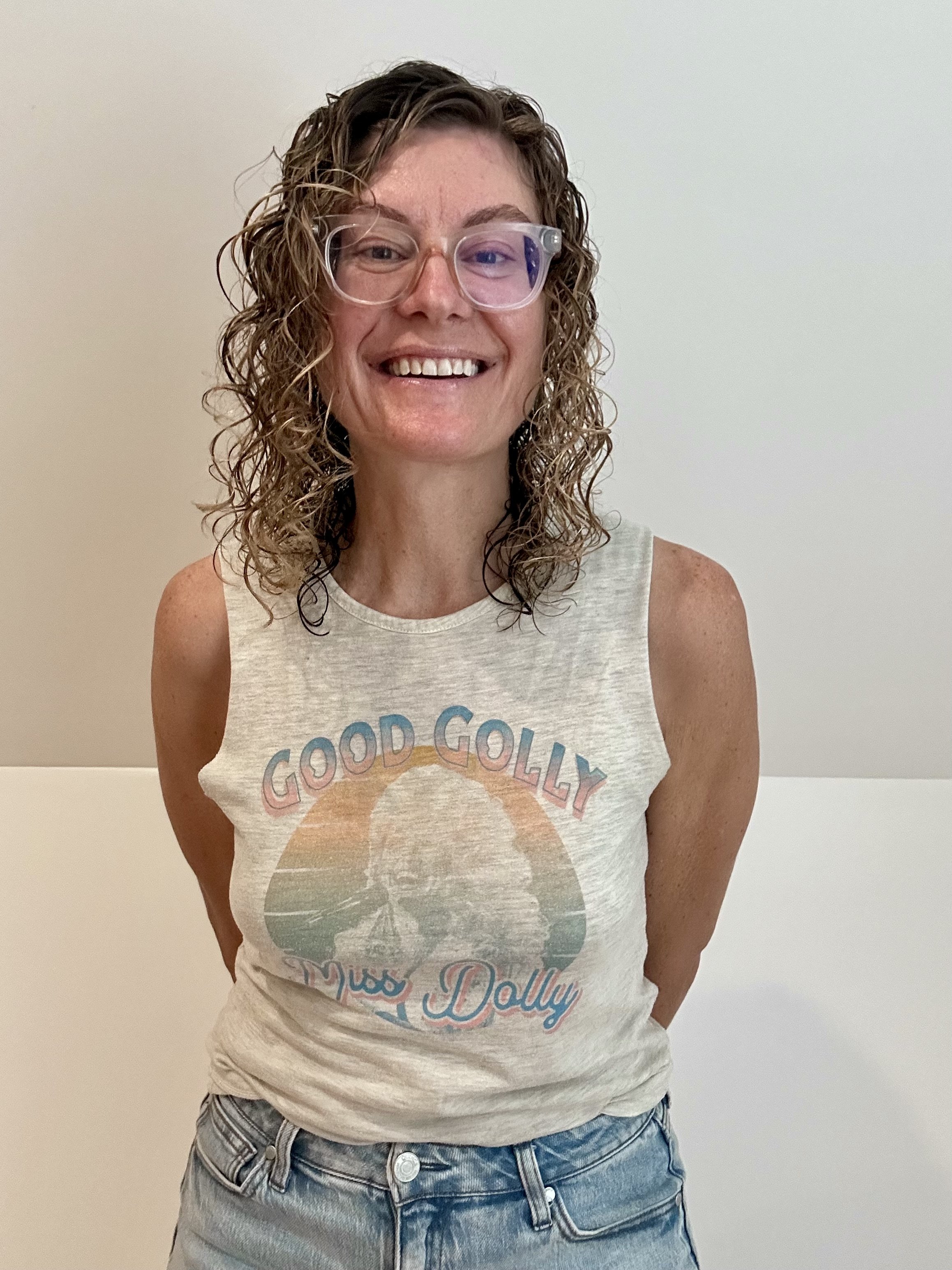
Me in my “Good Golly Miss Dolly” shirt from my birthday at Dollywood in 2022.